Reforming EU Innovation Funding: IEP Bocconi Contributes to a European Proposal in Science
An INPACT! proposal in Science, with contributions from IEP Bocconi, calls for a clearer path from scientific discovery to market

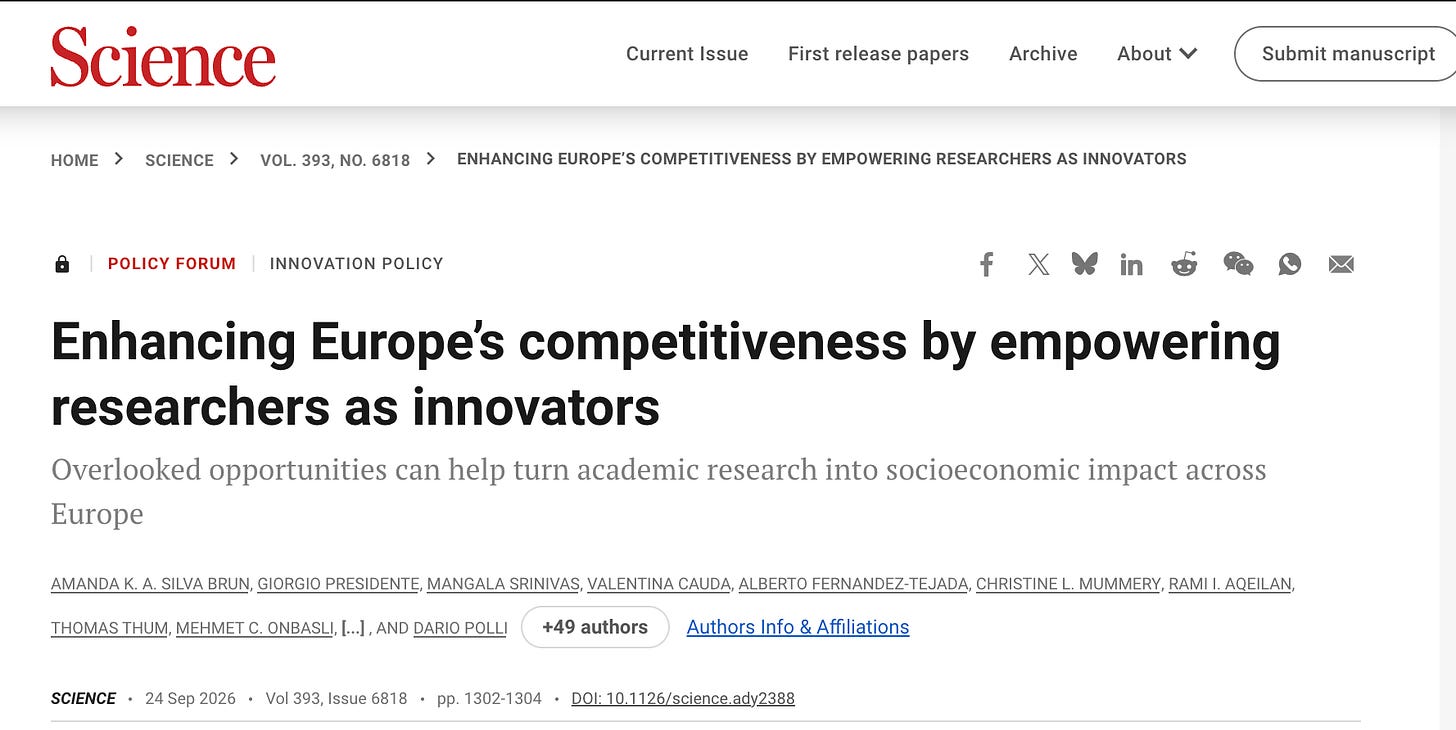
A new Policy Forum published in Science, one of the world’s leading peer-reviewed journals, examines Europe’s innovation weakness and discusses concrete ideas that can help turning scientific discoveries into products, firms and markets.
“Enhancing Europe’s Competitiveness by Empowering Researchers as Innovators” brings together more than 60 researchers and economists.
Three authors are affiliated with IEP Bocconi: Giorgio Presidente, Head of the Enterprises, Technology and Growth Unit; Daniel Gros, Senior Fellow; and Philipp-Leo Mengel, a postdoc at ifo Institute who has worked as a Research Assistant at IEP Bocconi.
The paper is an initiative of INPACT!, a bottom-up network launched in 2023 that brings together more than 120 scientist-innovators from over 20 European countries, mainly European Research Council grantees.
Its economic analysis builds on two years of joint work by IEP Bocconi with EconPol Europe at the ifo Institute, whose president is Clemens Fuest, and the Toulouse School of Economics, represented by Jean Tirole in the 2024 research.
In particular, the paper develops the arguments of the 2024 report “EU Innovation Policy: How to Escape the Middle Technology Trap” and the 2025 study “Funding Ideas, Not Companies”.
The diagnosis is that Horizon Europe, the EU’s €95 billion research and innovation programme for 2021–27, remains too fragmented and too focused on large collaborative programmes and mature technologies.
Promising discoveries often fall into gaps between the European Research Council’s Proof of Concept grants and the European Innovation Council’s Pathfinder, Transition and Accelerator programmes.
Although Proof of Concept funding improves the commercial use of ERC research, it receives only 1 to 2 per cent of the ERC budget.
Pathfinder and Transition, meanwhile, have about €500 million a year and only nine programme managers, far below the scale and managerial capacity of US ARPA agencies.
The authors recommend creating a continuous pipeline from ERC discoveries to market deployment by bringing Proof of Concept grants under EIC governance; shifting resources from underperforming programmes towards early-stage, high-risk innovation; giving independent programme managers greater authority; and replacing lengthy applications with shorter, more substantive assessments.
They also call for national agencies to co-finance excellent proposals that pass EU evaluation but remain unfunded, and for universities and technology transfer offices to reward entrepreneurship, professionalise intellectual-property management and provide researchers with starter funding, mentoring and clearer routes to commercialisation.
The central message is not simply that Europe should spend more, but that it must spend better, backing ideas and researchers rather than incumbents and administrative structures.
Giorgio Presidente, Head of the Enterprises, Technology and Growth Unit at IEP Bocconi, explains:
“Europe is caught in a middle-technology trap: we specialise in mature industries such as automotive and industrial machinery, while frontier sectors such as AI and biotechnology remain too small.
To strengthen Europe’s competitiveness and strategic autonomy, we must rebuild the pipeline from scientific discovery to market—funding the best ideas and enabling researchers and innovators to turn today’s breakthroughs into tomorrow’s high-tech industries.”
IEP Bocconi does not express opinions of its own. The opinions expressed in this publication are those of the authors. Any errors or omissions are the responsibility of the authors.


